
Select Your Mattress


It's the question that stalls most bed purchases. You've settled on a size and a budget, and then you reach the fork in the road: a solid divan base, or a slatted bed frame.
The divan bed vs frame decision is not really about looks, even though that's how it usually gets framed. It comes down to four practical things: how much storage you need, how easy your home is to get furniture into, how you want the mattress to feel, and how much of your budget belongs to the base rather than the mattress.
Here's an honest comparison of both, and a straight answer on which suits which situation.
Choose a divan if you want built-in storage without extra cost, your stairs or doorways are tight, or you'd rather spend more of the budget on the mattress.
Choose a bed frame if the look of the bed matters most, you want air circulating under the mattress, or you don't need storage built into the base.
Now the detail behind that.
A divan is a solid, upholstered box base that the mattress sits directly on top of. Most UK divans come in two halves that clip together, and the base can be ordered plain or with drawers built into the sides. Headboards attach separately with struts, so you choose the base and the headboard independently.
Browse the range of divan beds to see how the base and headboard combinations work.

A bed frame is a structural surround of wood or metal with a slatted platform supporting the mattress. The frame is the visible design: headboard, side rails, legs and sometimes a footboard. The mattress rests on slats rather than a solid surface, leaving open space underneath.
Our framed beds cover everything from solid pine through to metal and upholstered designs.
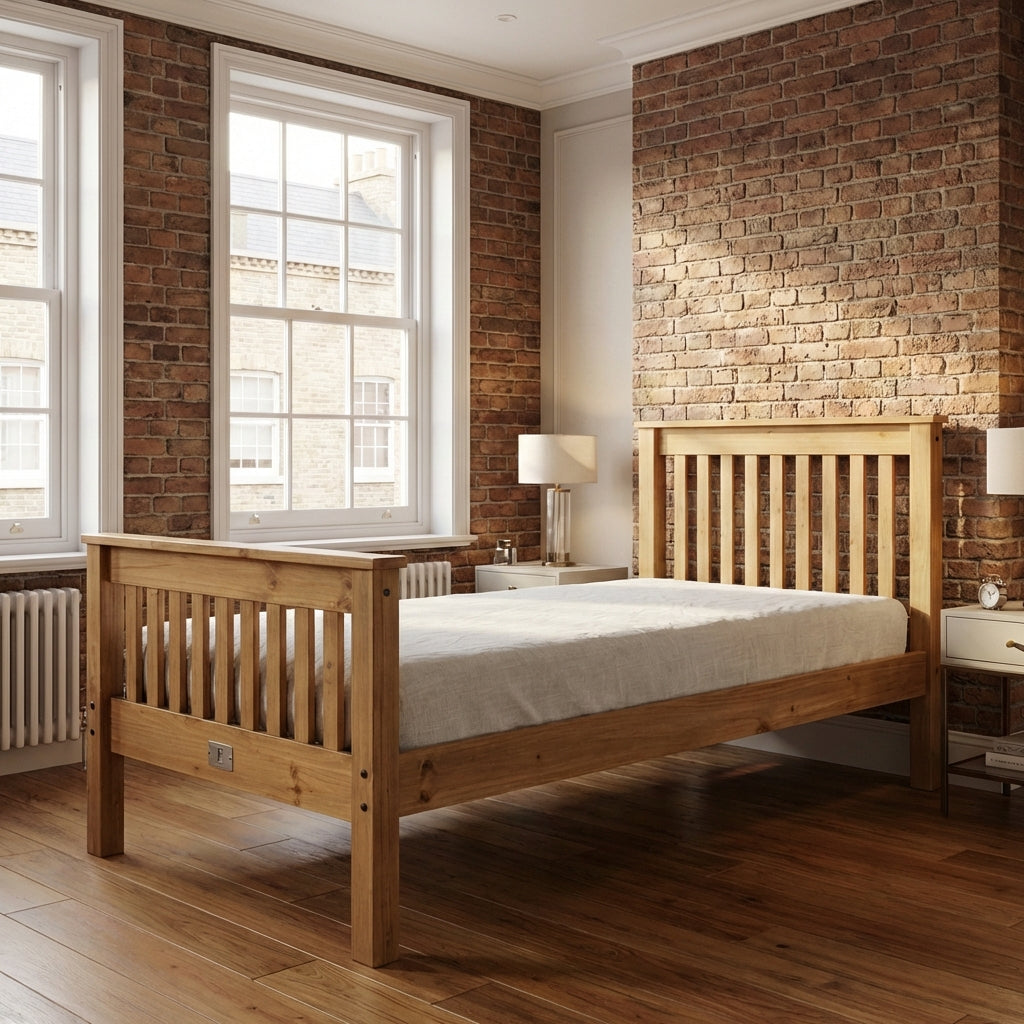
The case for a divan.
Storage is the headline. Drawers build directly into the base at a fraction of what separate under-bed storage would cost, and they're genuinely easy to use day to day. You open a drawer; you don't lift anything.
Access is the underrated advantage. Because a divan base splits into two halves, it gets around tight landings, up narrow staircases and through awkward door frames where a rigid frame simply will not go. If you live in a terrace, a flat with a turning stairwell or a loft conversion, this matters more than any styling consideration.
The solid base also gives completely even mattress support with no slat gaps, which suits most mattress types and tends to make a mattress feel slightly firmer. And because you buy the headboard separately, you can change the look of the bed years later without replacing the base.
Divans are usually the better value too, which leaves more of the budget for the mattress.
The case against.
Drawer storage only uses the shallow band of space at the sides of the base, so it holds far less than an ottoman. You also need floor clearance beside the bed for drawers to open, which is a real constraint in a narrow room. And a divan base has limited visual character of its own, so the headboard has to carry the design.
The case for a frame.
Design is the obvious one. A frame is a piece of furniture in its own right, and it anchors the room in a way an upholstered box cannot. Wood, metal, upholstered, low platform or tall four-poster: the range of looks is far wider.
Airflow is the practical advantage people overlook. Slats let air move around the underside of the matt ress, which helps manage moisture and suits foam and memory foam mattresses particularly well.
A raised frame also leaves an open floor beneath, which makes the room feel larger and lets you add your own under-bed boxes or drawers later.
The case against.
Frames rarely include storage, so you're buying it separately or going without. They arrive flat-packed and need assembling, and a rigid frame can be genuinely difficult to manoeuvre into an upstairs room.
Slat spacing also needs checking. Gaps wider than around 7cm can let a mattress sag between the slats, and some mattress warranties specify a maximum gap. Frames can develop creaks over time as joints loosen, though this is easily fixed by tightening the fixings.

1. Support and feel. A solid divan base reflects the mattress back at you and makes it feel firmer. Sprung slats flex slightly and make the same mattress feel a touch softer. Neither is better; it depends on what you like. If you're buying a base and mattress together, try them as a pair.
2. Storage. Divan drawers win outright against a plain frame. If storage is your main concern, though, neither is the best answer: an ottoman base uses the entire footprint under the bed rather than just the sides.
3. Access and delivery. Divans win clearly. A split base handles stairs and doorways that defeat a rigid frame. Measure your access before ordering either, because this is the most common reason a bed goes back.
4. Mattress compatibility. Most mattresses work on both. Foam and memory foam benefit from the airflow of a slatted frame. Check slat spacing against your mattress warranty if you choose a frame.
5. Cost. Divans generally offer more beds for the money, especially once storage is factored in. Frames range more widely, from budget metal to premium hardwood.
6. Longevity. Both last well. A divan base is harder to repair if damaged, while a frame can usually be tightened or have a slat replaced.
Small bedroom needing storage: divan with drawers, or step up to an ottoman if you need more capacity than drawers offer.
Narrow room, one side against a wall: divan with drawers specified on the open side only.
Tight stairs, narrow landing or a loft room: divan, for the split base.
Main bedroom where the bed is the focal point: frame.
Foam or memory foam mattress: frame, for the airflow.
Guest room: frame, since storage matters less and the budget can go on the look.
Tight budget with a good mattress as the priority: divan.
Still weighing it up? Our full bed range lets you see both base types side by side.
Yes. Divans offer even mattress support, built-in drawer storage, easy delivery through tight spaces and strong value. Their main limitation is storage capacity compared with an ottoman, and the need for floor clearance to open drawers.
Neither is better overall. Divans win on storage, access and value; frames win on design, airflow and open floor space beneath. Decide on your storage needs and your access first, then choose the look.
The three main bed base types are divan, ottoman and framed. Divans use a solid upholstered box, ottomans lift on gas struts to reveal storage, and framed beds use a slatted platform within a structural frame.
Almost always, yes. The solid surface supports every common mattress type evenly, and will tend to make a mattress feel slightly firmer than the same mattress on sprung slats.
They can over time as joints loosen, though tightening the fixings usually resolves it. Solid hardwood frames and well-made metal frames are least prone to it.
Feel is difficult to judge online. The quickest way to settle the divan bed vs frame question is to sit on both and try a drawer for yourself. Browse divan beds and framed beds online, or visit our Leeds showroom where our team can check your access measurements and help you pair the right mattress. Get in touch today.
